Google Ads vs Facebook Ads: Which Platform Should You Use?
Google Ads vs Facebook Ads: which platform should you use?
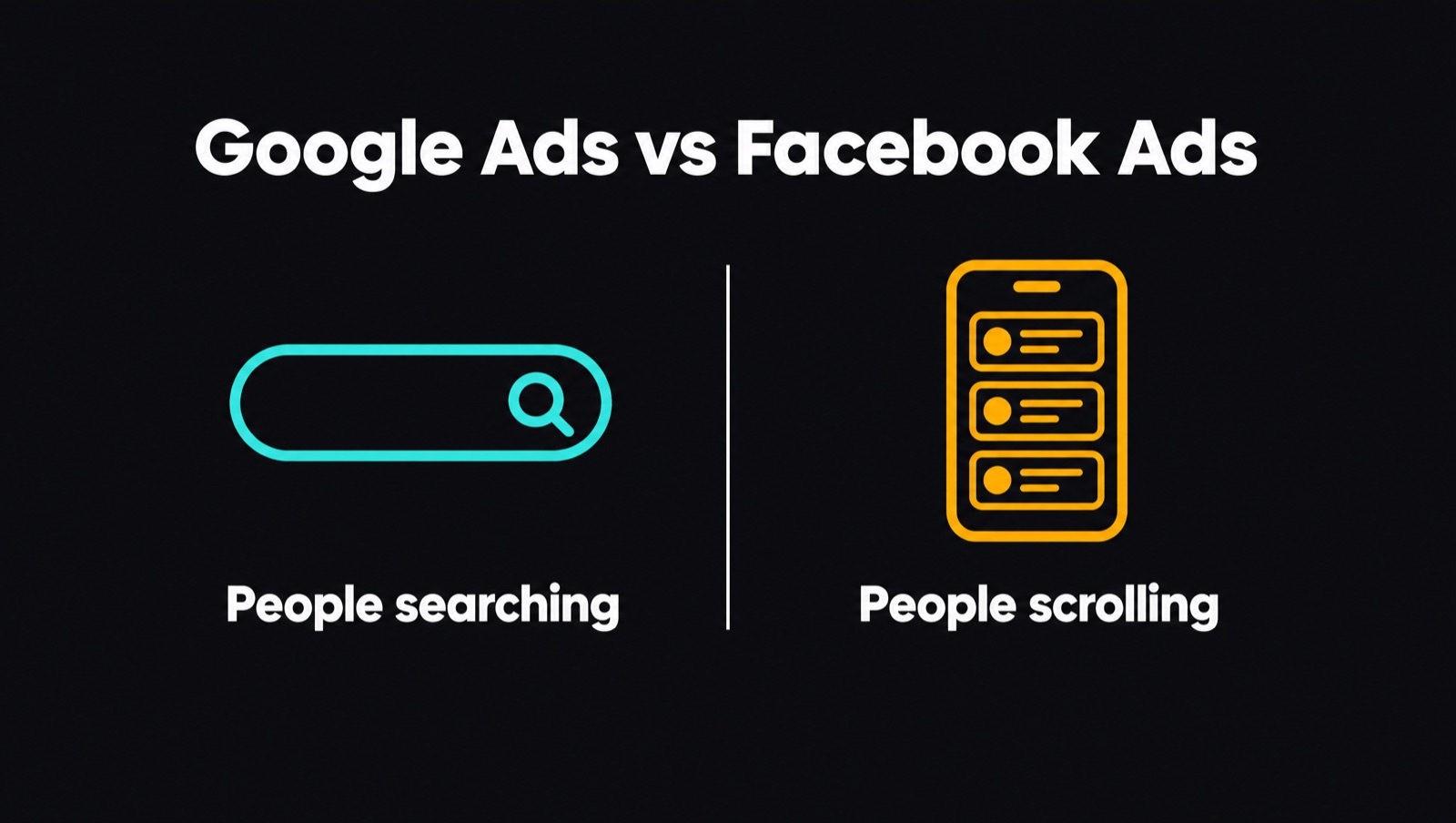
Use Google Ads if people already know what you sell and search for it. Use Facebook Ads if your product or service is new, visual or needs explaining.
That's the first thing I look at when a client asks which platform they should be on. Facebook Ads are now called Meta Ads and cover Instagram too, so I'll use both names here.
After that I look at three more things: how urgently people buy, what a click costs compared with what a customer is worth, and how quickly the cash comes back into the business. Below I'll go through each one, show you how two of our clients used the platforms, and give you my pick for six types of business.
Start with one question: do people already search for it?
Google suits what people already know
Google is really good for existing services and products that people know about. Think lawyers, locksmiths, plumbers and landscapers, or eCommerce products that are commonly known and accepted.
People already understand what these are. When they need one, they type it into Google, and your ad shows up while they're looking.
Facebook suits what needs explaining
Facebook is really good for products or services that are unknown, that need a visual, or that have a twist on them.
A good example of a twist is the phone case with the little ring on the back. Phone cases weren't new, but the ring was. Nobody was searching for it, because nobody knew it existed. You had to show it to people.
The same goes for a service where you need to explain what makes yours different. A money-back guarantee on agency services is a good one. People aren't searching for it, but it can do well on Facebook because the ad gives you room to explain the difference.
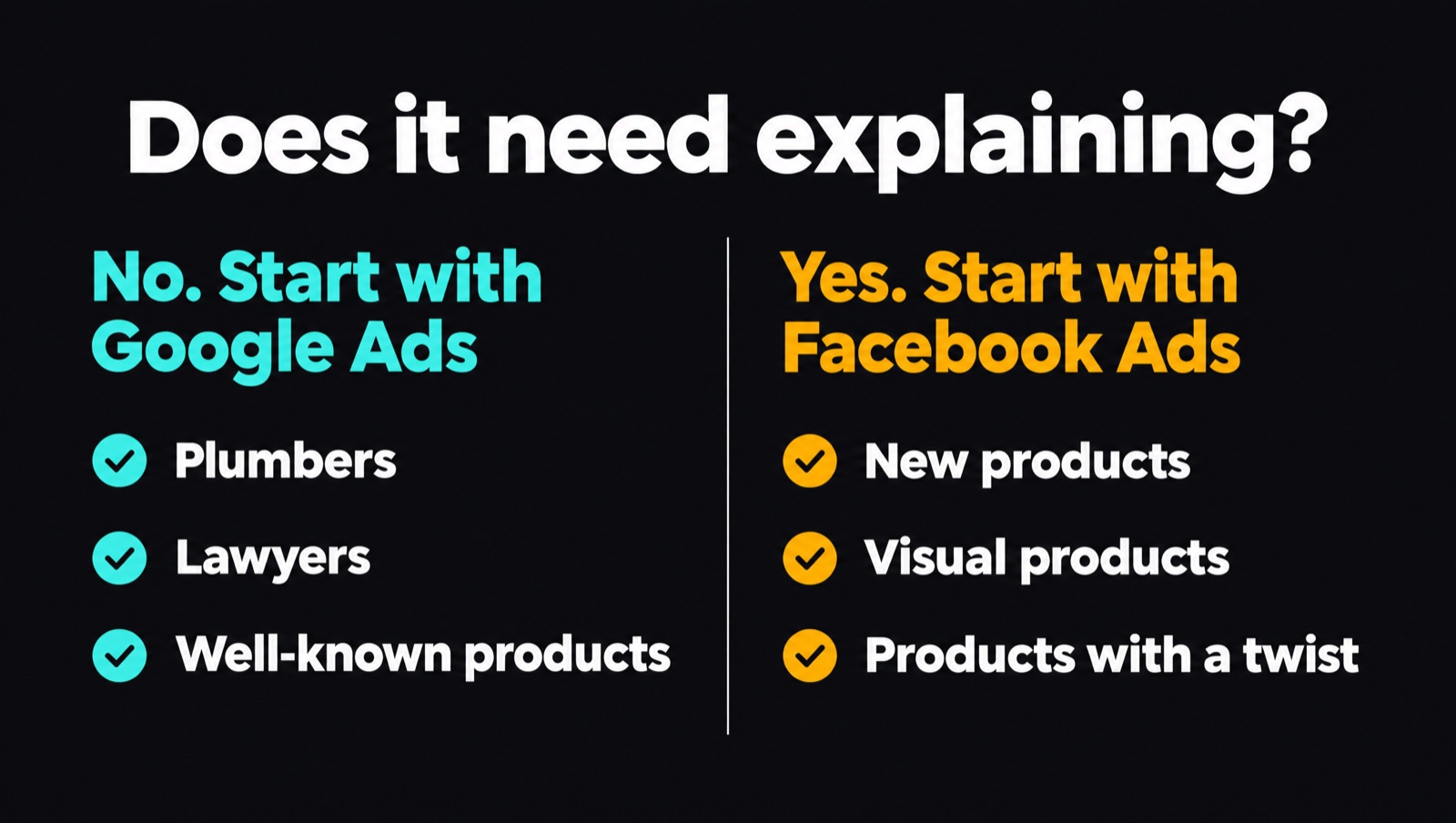
There's typically a pretty clean line here. If your product needs to be explained, Facebook is usually the more viable platform. If it doesn't, it's usually Google.
How urgently do people buy?
The second thing I look at is how people buy.
If your sink bursts, you're not going to jump on Facebook to find a plumber. You're going straight to Google. It's the same if you're locked out of your house. You want someone quickly, so you search.
Urgent, reactive purchases belong on Google. If you run an emergency trade, here's how we run Google Ads for plumbers.
Price matters too. If what you sell is more expensive and people research it before they buy, you'll sometimes need a split. Facebook works at the top of the funnel, getting you in front of people early. Google works at the bottom, when they're ready to choose.
What a click costs against what a customer is worth
Both platforms typically need a minimum of $50 a day to get good data and some traction. There's the odd situation where $20 a day works, which I cover in is $20 a day good for Google Ads?. My general recommendation is to start at $50 a day.
Then compare your average order value with the cost of a click. In some industries the cost per click on Google, set against what a customer pays you and when they pay it, makes Google not viable.
Why I'd lean towards Meta for accountants
Accountants are a good example. A client has a good lifetime value, but Google clicks are expensive because you're bidding against big companies like Xero and MYOB.
Even when you do win a client through Google, the time it takes to get that cash back into the business can be draining. It limits how many clients you can afford to bring on.
Meta typically gives a better return on ad spend in that situation. The cost per click and the cost per 1,000 impressions, which is how much it costs to get in front of people, are typically cheaper on Meta than on Google.
How two of our clients used each platform
A telehealth provider: Meta for the unknown, Google for the private
We ran Google and Meta Ads for a telehealth provider that added more than 600 new patients in a year. Most of that came from Meta, with Google picking up the bottom of the funnel.
Meta did well for the services people didn't know were available to them. A lot of the performance came from getting in front of people who weren't aware a solution existed, with separate campaigns for separate types of patient.
Google did well on the conditions people find a bit embarrassing, like erectile dysfunction and premature ejaculation. People were less inclined to interact with a Facebook ad for those services. They'd search for them privately on Google.
So the split inside one business came down to the condition. If it was unknown, it went on Meta. If it was private, it went on Google.
A supplement brand: Meta for sales, Google for the brand name
We took a supplement brand from $15k to $90k a month in revenue in 13 months. That was done entirely through Meta Ads.
The supplement solved a problem most people didn't know had a product for it, so people weren't searching for it. It needed explaining and it needed a visual, and Meta gives you both.
Google had one job in that account, which was protecting the brand name. Once people had seen the ads and searched for the brand, we made sure they found it.
You can read both case studies on our results page.
What each platform needs from you
Meta needs creative, video and a strong offer
Meta is as cold as traffic gets, because nobody is looking for you. There's some control over who sees your ads through targeting, but the ad itself has to do the work. If there's nothing in the ad that invites people to click, they're never going to click.
That means a lot of creative testing. At the start you need to work out:
- What style works. Talking to camera, a static image, UGC or some other type of footage.
- What offer works. The offer is a stronger lever on Meta, because your ad is showing to people who may or may not be interested.
- What angle works. Whether people respond to the pain point or the desire.
Once you've found what works, the creative usually needs refreshing every 1 to 2 months.
Google needs the right keywords and a good website
Google targets at the keyword level, so you need to be confident about what people are typing in. Research which terms are commercial and which are transactional.
On Google, people are searching for your product or service, so the intent is generally stronger. Performance comes down to your website and your offer significantly more than the ad. Your landing page and your tracking both matter a lot.
"We tried it and it didn't work"
When Facebook didn't work
When someone tells me they tried Facebook and it doesn't work, I ask what the ads looked like, what the website looked like and what the targeting was.
If you put out one poor quality ad and spend $5 a day on a $3,000 product, it's not going to work. For a fair test you need three things:
- Enough spend to call it a test.
- An ad that's engaging and attractive.
- A landing page and offer that are attractive, clear and concise.
If your ads used to work and then stopped, run through our audit for Facebook Ads that stopped converting.
When Google didn't work
With Google, the biggest failing point is whether you got relevant people to your website.
Look at your search terms, which are different from your keywords. Were the people clicking looking for your product or service? Or was it clicks from people searching for a competitor, or for DIY and free options?
I go through how to check this in why your Google Ads aren't getting conversions.
When to run both
If you can only afford one platform, go back to the first question. Is your product known and searched for, or does it need explaining?
Before I add a second platform, the first one needs to be profitable. Work out what went wrong on the first channel and fix it before you take on another.
When both are running, I split the budget on performance, and the split changes as the returns change. I think fixed ad spend per channel is silly. Each channel has its pros and cons, and one of them will be performing better. That assumes your tracking measures both in a similar way.
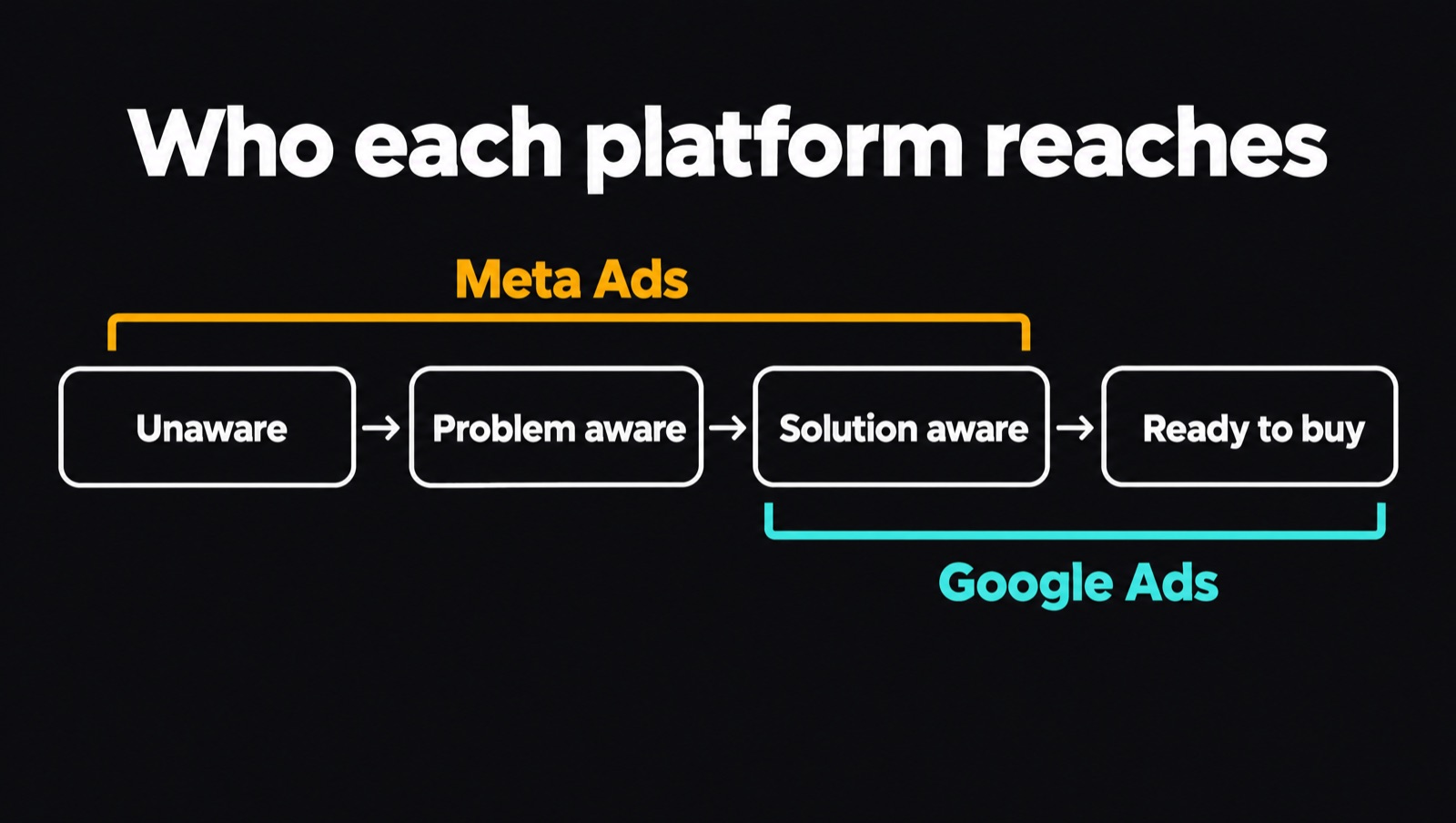
The benefit of running both is that you reach people at different stages:
- Meta reaches people who are unaware, problem aware or solution aware.
- Google reaches people who are solution aware and comparing their options, and people who are ready to buy.
Whichever way you go, run a brand campaign on Google to protect your brand name if your SEO isn't strong enough to hold the top spot.
Two pieces of common advice I disagree with
Broad match keywords on Google
I disagree strongly with using broad match keywords. They typically underperform because you get poor quality matches. I recommend phrase and exact match. I explain why in broad match vs exact match.
No targeting at all on Facebook
The common advice on Facebook is to run with no interest targeting and let the algorithm find your buyers. I'd only do that if you're spending a fair bit of money, your creatives are really specific and your pixel is well seasoned.
For most people, giving Facebook an interest to start with is a better use of money. You're giving it a direction to go in.
Say you're a web developer who builds Shopify stores. Facebook has an interest for people who are interested in Shopify. Your ad creative can do a lot of the heavy lifting, but if you're brand new with no data, I'd add that Shopify interest.
You can also leave the interest as a suggestion, which Facebook uses as a guide and not a strict rule. That's a nice middle ground. The algorithm has room to breathe and still has an idea of where to go. If you want to test it, run a broad ad set alongside. I'd typically expect the Shopify audience to perform better.
Which platform I'd start with, by business type
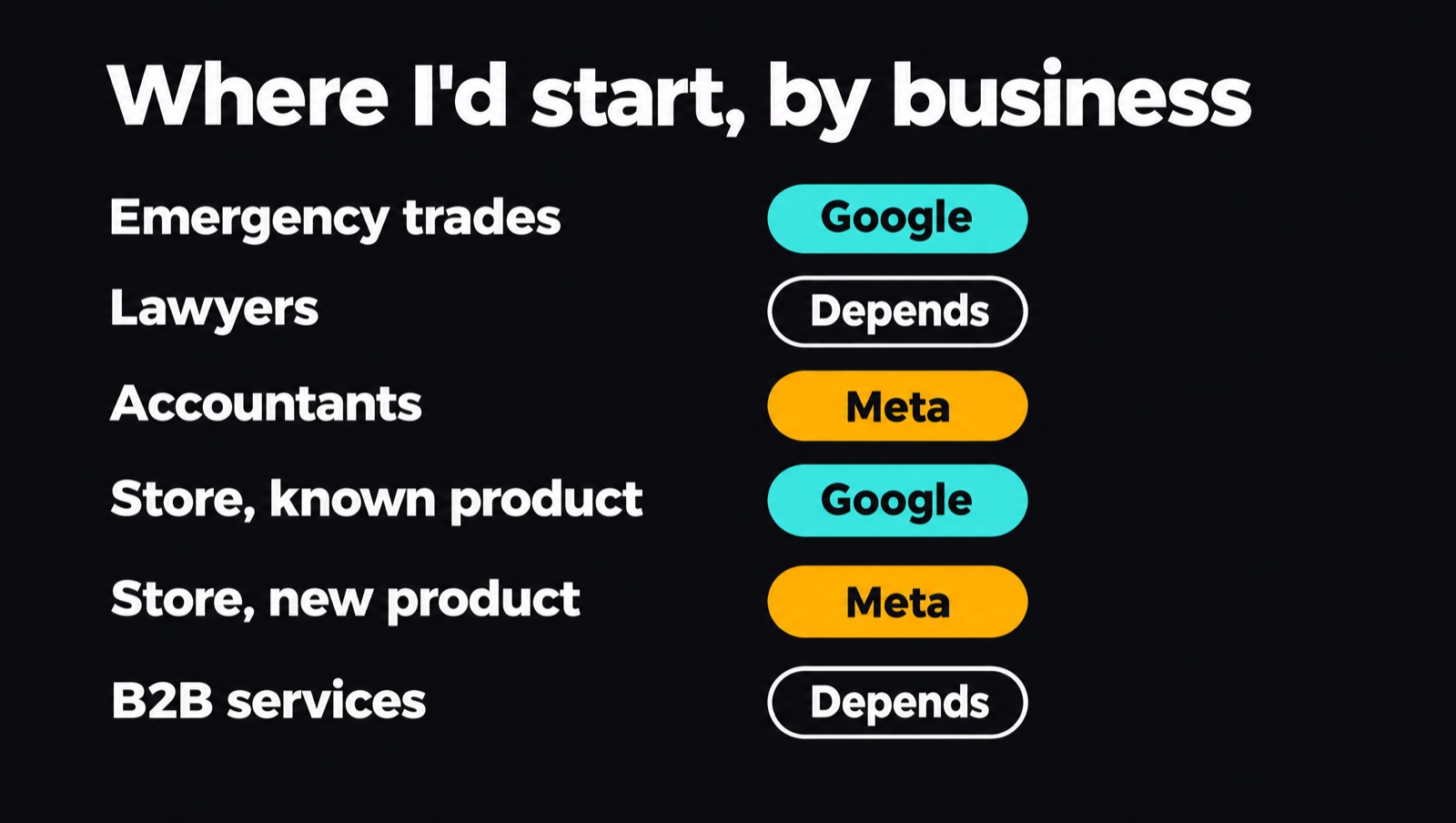
- Plumbers and emergency trades: Google. People don't open the Facebook app in an emergency. They go straight to Google.
- Lawyers: it depends on the type of law. Litigation, family law, divorce, immigration and employment law belong on Google. If you help people before there's any urgency, like wills or prenups, Meta could do really well. Here's how we run Google Ads for lawyers.
- Accountants: Meta. Google is really expensive because of the big companies bidding on the same searches.
- An online store selling a well-known product: Google first, then expand to Meta.
- An online store selling something new: Meta.
- B2B services: it depends on the service. A B2B sales training company is probably more of a Google business, because people search for it. I'd also throw in a curveball here, which is LinkedIn Ads. If you help founders raise seed money, for example, that could be a LinkedIn campaign.
So which one should you use?
If people already search for what you sell, start with Google. If you need to show it or explain it, start with Meta. Start at around $50 a day, get the first platform profitable, then add the second.
If you'd like someone else to run it, that's what our Google Ads management and Meta Ads management are for. You can see more about how we work at Senior Ad Managers.
FAQ
It depends on whether people already search for what you sell. Google Ads is better for known products and services like plumbers, lawyers and common eCommerce products. Facebook Ads are better for new products, visual products and offers that need explaining.
Typically, yes. The cost per click and the cost per 1,000 impressions are usually lower on Meta than on Google. In industries with expensive Google clicks, like accounting, that can make Meta the better place to start.
Both platforms typically need a minimum of $50 a day to get good data and traction. There's the odd situation where $20 a day works, but $50 a day is my general recommendation.
Start with one. Add the second once the first is profitable and you've worked out what went wrong along the way. When both are running, split the budget on performance and keep it flexible.
It usually comes down to the ad, the landing page and offer, or the size of the test. One poor quality ad on $5 a day for a $3,000 product was never going to work. You need to spend enough to call it a fair test.
They can, depending on the service. Google suits B2B services people already search for, like sales training. For some B2B offers, LinkedIn Ads are worth a look because you can reach a specific type of person.
Keep reading
How we can help
Next step
Find out where your ad spend is going.
Get a $99 AUD Google Ads audit. We'll show you where money is being wasted and which leads you're missing out on.
Show me my current ad mistakes →