Is $20 a Day Good for Google Ads? It Depends on Your Click Costs
Is $20 a day good for Google Ads?
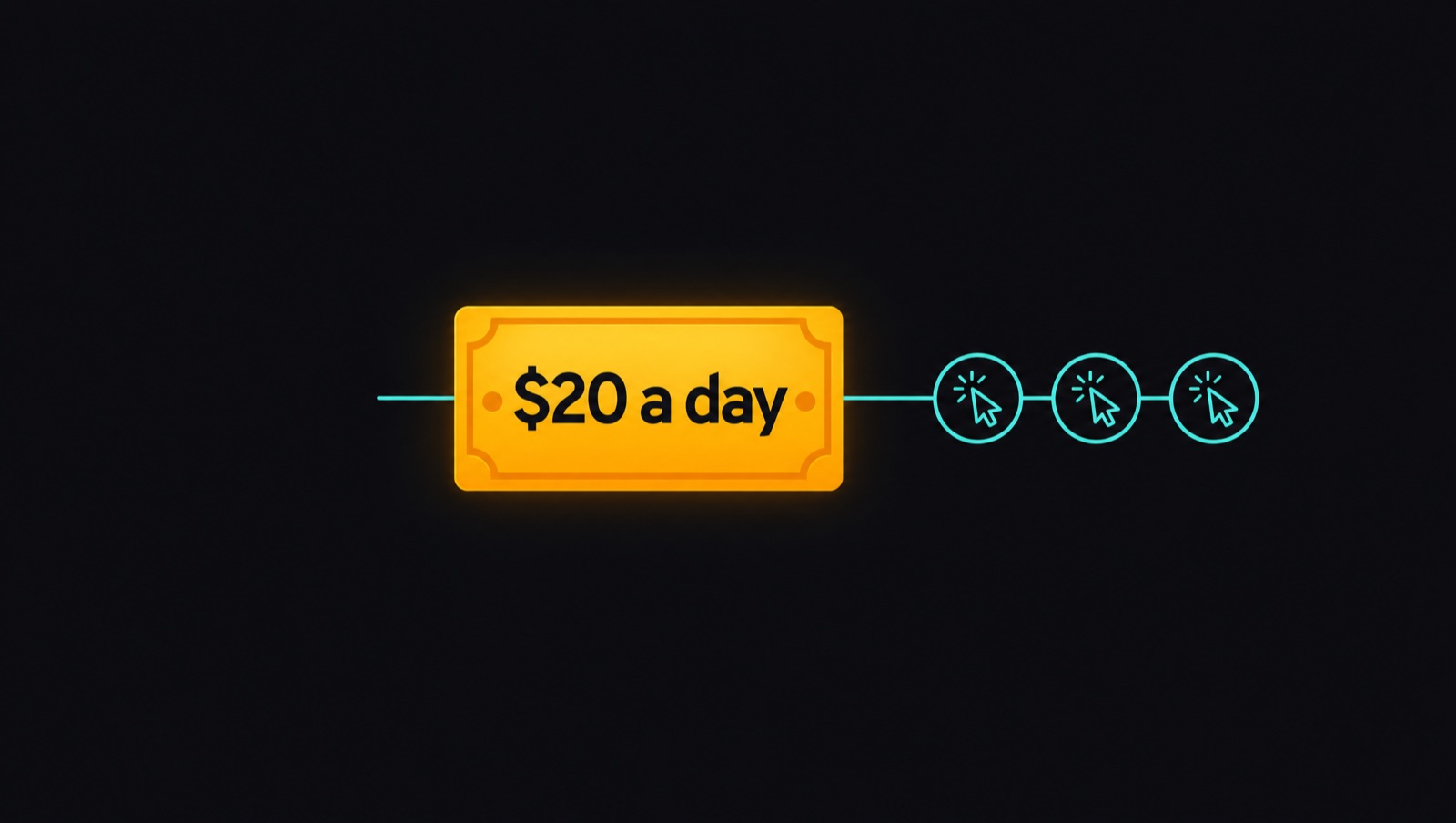
$20 a day is good for Google Ads if you're in a low competition niche where clicks are cheap. If you're running a Search campaign to get new customers and your clicks cost $1 to $3, it can be profitable. It's also fine for a YouTube campaign built for awareness, or a small display remarketing campaign that keeps you top of mind.
In plumbing, legal or accounting, it's a different story. Clicks in those areas are expensive, and in some cases one click can cost more than the whole $20. You'll struggle to buy enough traffic, and the traffic you can afford usually isn't ready to buy.
Below I'll show you what we've seen on small budgets, the setup I'd use if I only had $20 a day, how to tell if it's working, and when to raise the budget.
Your cost per click decides what $20 a day can do
$20 a day is about $600 a month. What that buys depends almost entirely on your cost per click.
- At $2 a click, you get about 10 clicks a day.
- At $9 a click, you get about 2 clicks a day.
- At $16 a click, you get about 1 click a day.
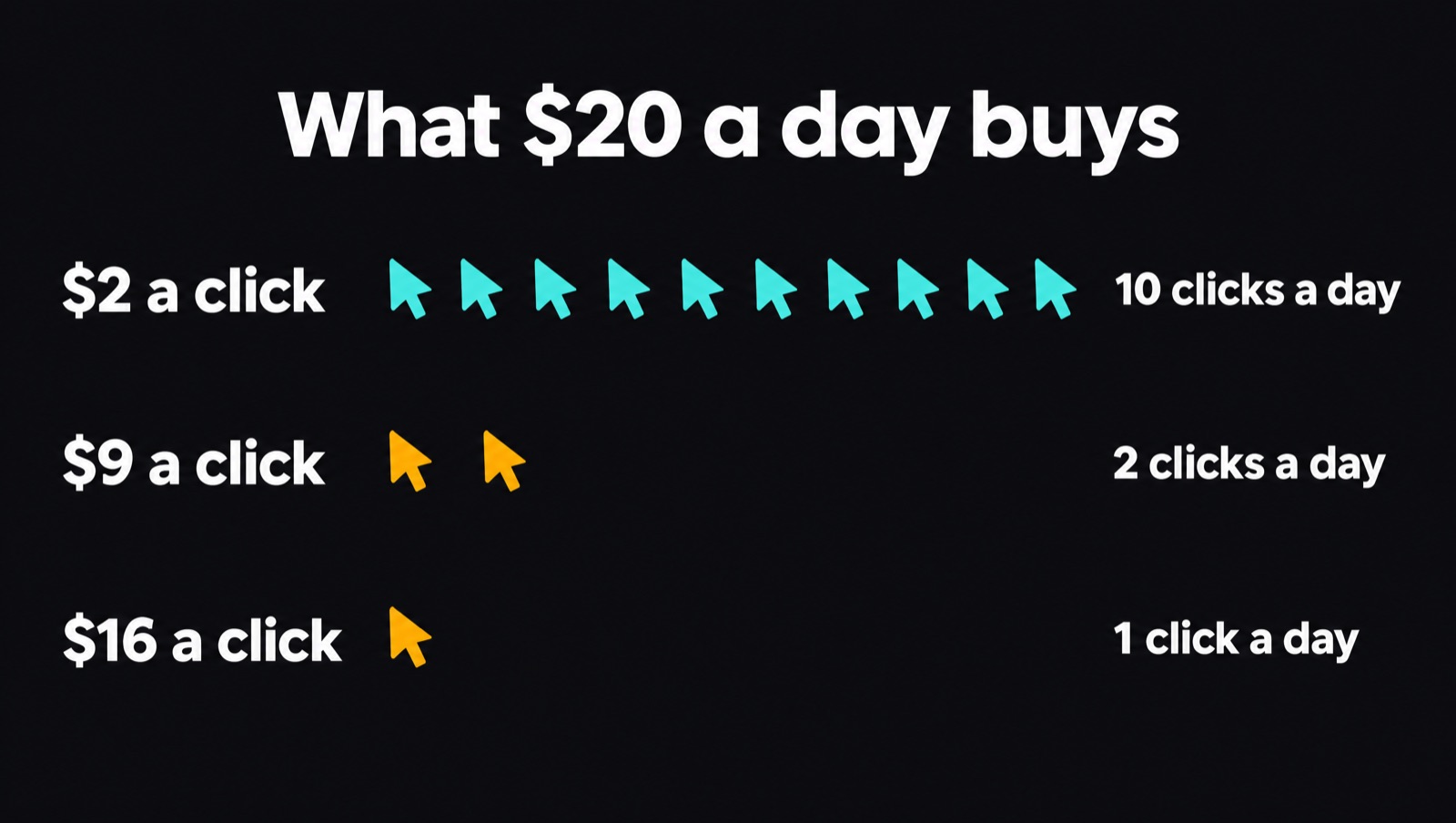
I look for at least 7 to 10 clicks a day, which I explain in why your Google Ads aren't getting conversions. On $20 a day, that means your clicks need to cost around $2 to $3. If they cost more than that, you're likely under budgeted.
What we've seen on small budgets
Car hire: $10 leads on a $300 average order
We've had car hire accounts getting leads for $10 with an average order value of $300. That was quite profitable for them. There's plenty of room in those numbers, even when a lot of the leads don't book.
Handyman: about a lead a day on $30 a day
We've also had handyman companies spending $30 a day and getting leads in the high $20s, which works out at about one lead a day. Clicks for these clients were in the $1 to $3 range, and that's the main reason a small budget could work for them.
Pest control: when a small budget buys the wrong people
A pest control company was spending $50 a day and paying $9 a click. That budget was buying research traffic and not people ready to buy, and their cost per conversion was $700.
When we changed the strategy, their cost per click went up to $16. Their cost per conversion dropped from $700 to the low hundreds, and it has kept falling over time. They paid almost twice as much for each click and got far cheaper customers.
This happens because you need to buy the correct search intent and the correct user. Google knows when someone has searched multiple times and is warm, and it treats that person as worth more. That's where click costs start to skyrocket, and it's where a low budget becomes unprofitable or not worthwhile. You can still get clicks on a low budget. They just aren't qualified or high intent.
I've seen campaigns fail on $20 a day, and on anything under $50 a day, for this reason. The click costs in the niche were more than the budget could sustain.
Profitable on $20 a day doesn't mean you can pay for a manager
Our minimum to hire us is about $1,500 a month in ad spend, which is about $50 a day. That doesn't mean $20 a day can't bring you a profitable campaign. It can.
The problem is the margin. Each job has to pay for your materials, your profit and the cost of getting that job. Paying a media buyer on top of all that gets much harder at $20 a day.
Here's an example using our own pricing. Our management fee starts at $1,725 a month. Add $600 in ad spend and you're at $2,325 a month. If your gross margin is 50%, you'd need $4,650 a month in sales from the ads just to break even. That's a tough ask from $600 of clicks.
So if you're on $20 a day, I'd run it yourself. Here's how.
How I'd set up Google Ads on $20 a day
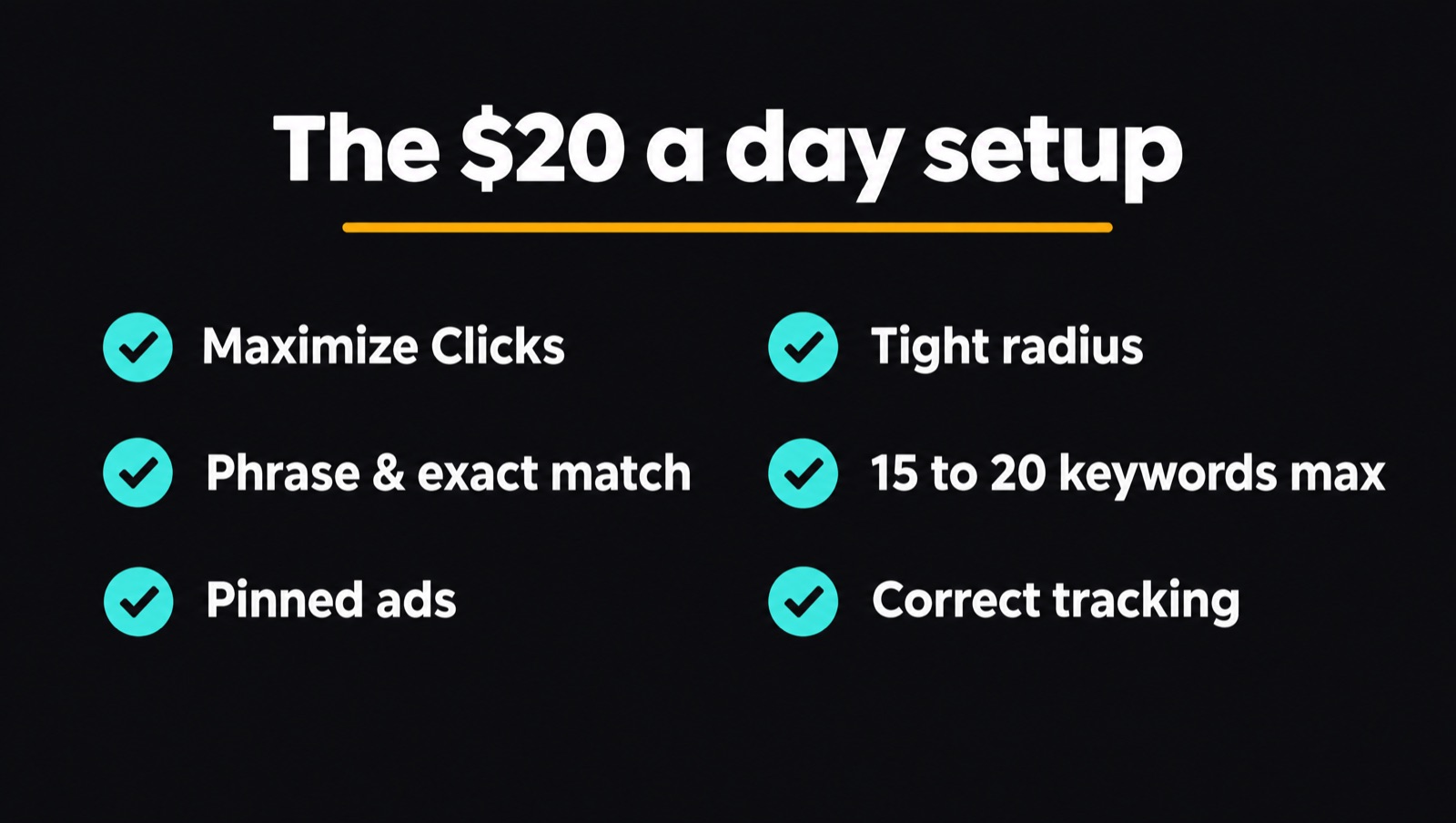
I disagree with two pieces of advice you'll hear a lot: use broad match, and use Maximize Conversions from day one. Here's what I'd do instead:
- Start on Maximize Clicks. This gets better data into the account and shows you what's working.
- Keep a tight radius. Only show your ads close to where you work.
- Use phrase and exact match keywords. Broad match will burn through your daily budget on irrelevant clicks. Our guide to broad match vs exact match goes into more detail.
- Keep it to 15 to 20 keywords at most.
- Pin your ads. This keeps the messaging tight and relevant to the search.
- Make sure your tracking is fully correct. Every decision you make later depends on it.
Why I wouldn't start on Maximize Conversions
Maximize Conversions typically drives click costs significantly higher. Without data in the account, Google isn't confident it can get you results, and it may not be able to bid effectively at all.
I'd switch once you have 2 to 4 months of solid conversion data. If you switch before that, you're handing Google control of the bidding when it doesn't have a clear understanding of what's performing.
The exception is a very high competition account. There, starting a new account on Maximize Conversions with no conversion data is typically advantageous, because you need to be bidding at the level the competition demands. That's what we saw with the pest control account above. Moving off Maximize Clicks took them from $9 to $16 a click, and that's where the better customers were.
How to tell if $20 a day is working
Start with what a customer is worth to you
How long you can wait depends on what a customer is worth. If a customer is only worth $5, I'd stop the campaign after 2 to 3 days of no sales. If a customer is worth $2,000, you have a much longer runway to gather the right data and make the right decisions.
Compare your cost per customer with two numbers: what the customer is worth over their lifetime, and how much cash you collect up front. If a customer is worth $2,000 but you only collect $500 at the start, I'd work towards the $500 first. This means you don't run into cash flow issues while you wait for the rest.
Use these click benchmarks
As a general rule of thumb:
- 1 conversion per 20 to 30 clicks is a good benchmark.
- 1 conversion per 50 clicks is the stretch goal. Above that, I'd start to get worried.
- Up to 50 clicks with no conversions and I'd be a little concerned.
- 100 clicks with no conversions means something is desperately wrong.
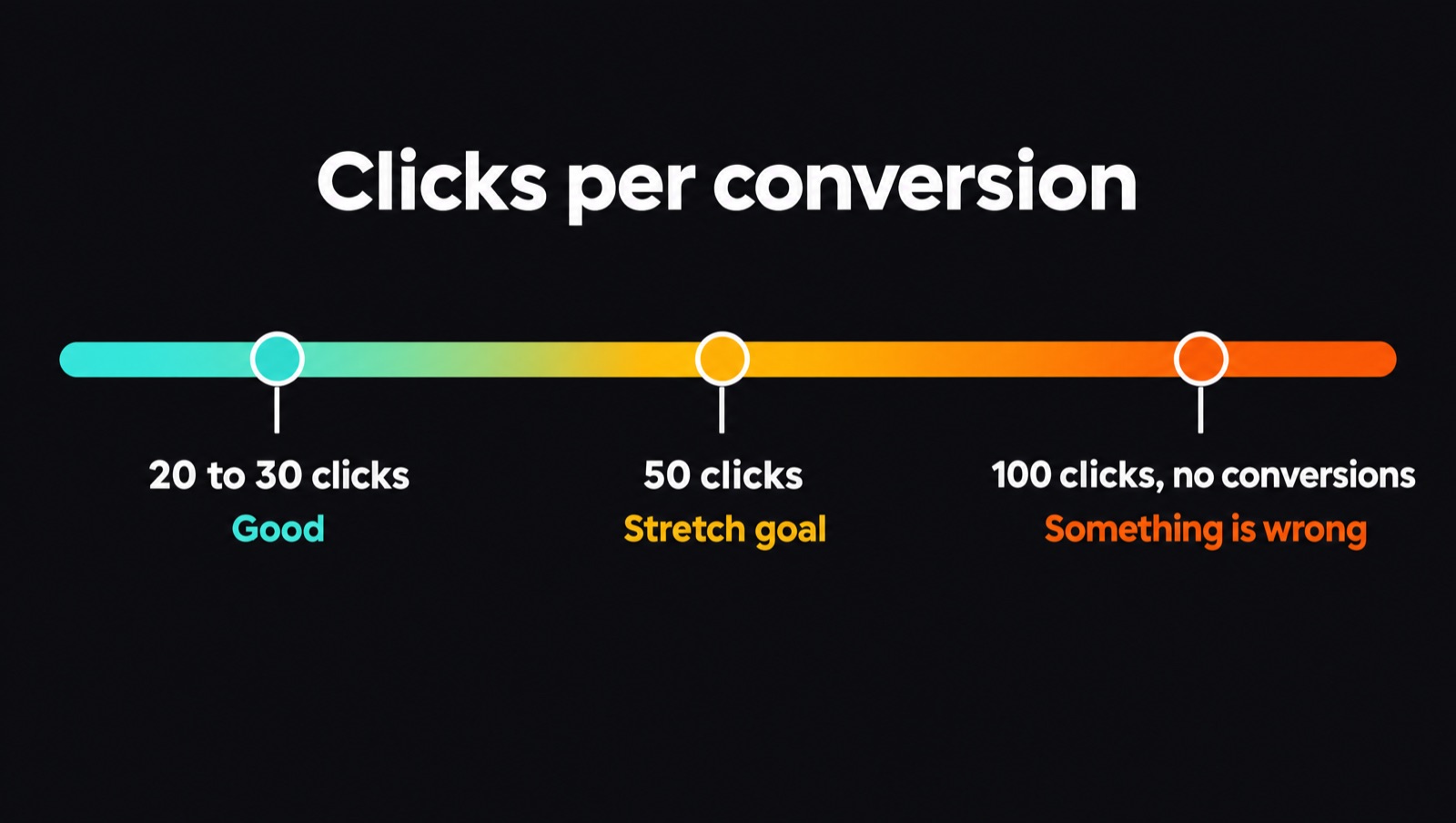
Your click cost also decides how quickly you'll get an answer. At $2 a click, you'll reach 100 clicks in 10 days for $200. At $15 a click, the same 100 clicks would cost $1,500 and take 75 days on $20 a day.
Keep the account clean while you wait
These benchmarks assume you're looking after the account. While the data builds, make sure you're:
- Monitoring your search terms and keeping them relevant and clean
- Matching your ad messaging to your landing page
- Going after buyer intent, with words like services, company, near me and hire
Those words show someone wants to pay for the service, and that's who a small budget needs to reach. I go through research keywords and the other common Google Ads mistakes that cost money in a separate post.
When to raise your budget
Whether you raise the budget or stop depends on your cost per customer compared with what a customer is worth. If the numbers work, raise the budget by a maximum of 20% every 2 weeks.
On $20 a day, that takes you to $24 a day after 2 weeks, then about $29 a day 2 weeks later. It feels slow, but you can see whether your cost per customer holds up as you spend more.
What to do if you're in plumbing, legal or another expensive niche
If you're in something like plumbing or legal, I'd look at a minimum of $50 a day. Then keep your targeting tight based on where you are:
- In a highly dense area, use a radius of 8 to 10 kilometres around your local area. In somewhere like New York, I'd use an 8 kilometre radius.
- In a slightly less dense city of around 3 to 5 million people, I'd probably target the whole city.
We cover the targeting we use in each city on our Google Ads pages for Melbourne, Sydney, Brisbane and Perth.
$50 a day at $15 a click is still only about 3 clicks a day, so keeping your keywords tight and your search terms clean matters even more here.
So should you spend $20 a day on Google Ads?
If your clicks cost $1 to $3 and your numbers leave room for profit, yes. Start on Maximize Clicks, keep the setup tight, get your tracking right and judge it against what a customer is worth to you.
In high competition niches like plumbing, legal or accounting, $20 a day will probably buy you research traffic. I'd save up until you can spend at least $50 a day. It's also worth checking whether Meta suits your business better, which I cover in Google Ads vs Facebook Ads.
Once you're spending $1,500 a month or more and want someone else running it, that's where our Google Ads management fits. You can see more about how we work at Senior Ad Managers. If you'd like your setup checked before you spend more, our $99 audit covers that too.
FAQ
It can be enough for a Search campaign in a low competition niche where clicks cost around $1 to $3. It's also fine for a small YouTube awareness or display remarketing campaign. It usually isn't enough in plumbing, legal or accounting, where click costs can use up most or all of the budget.
Start with Maximize Clicks so you can build up data and see what's working. Move to Maximize Conversions once you have 2 to 4 months of solid conversion data. The exception is a very high competition account, where starting on Maximize Conversions is typically advantageous even with no conversion data.
A good benchmark is one conversion for every 20 to 30 clicks, with 50 as the outer limit. I'd be a little concerned at 50 clicks with no conversions. At 100 clicks with no conversions, something is badly wrong.
No. Broad match can burn through a small daily budget on irrelevant clicks. Use phrase and exact match, and keep it to 15 to 20 keywords at most.
Raise it by a maximum of 20% every 2 weeks, and base the decision on your cost per customer compared with what a customer is worth to you.
I'd look at a minimum of $50 a day, with a tight radius of around 8 to 10 kilometres in a densely populated area. In a city of around 3 to 5 million people, I'd probably target the whole city.
Keep reading
How we can help
Next step
Find out where your ad spend is going.
Get a $99 AUD Google Ads audit. We'll show you where money is being wasted and which leads you're missing out on.
Show me my current ad mistakes →